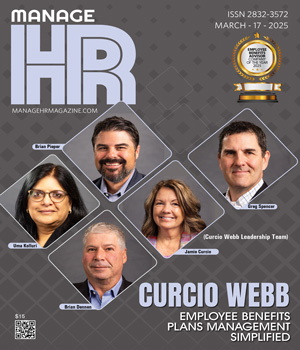
Curcio Webb: Employee Benefits Plans Management Simplified

Employee Benefits Advisor Company Of The Year – 2025

The HR and talent acquisition space is undergoing a seismic shift driven by technological advancements and a heightened focus on diversity and inclusion. Organizations that prioritize the integration of DEI principles with sales training in their HR strategies are better equipped to attract diverse talent and foster equitable workplaces.

The global human resource professional services market was valued at $6.39 billion in 2024 and is projected to grow at a CAGR of 13.4 percent from 2025 to 2030. The growth can be attributed to the heightened importance of ensuring fairness in decision-making during the hiring process and promoting a sense of belonging among employees to boost retention.

Companies are driving their efforts to create inclusive workplaces by implementing blind hiring practices, forming employee resource groups, and conducting regular audits of hiring and promotion processes. More than ethical obligations, these initiatives serve as catalysts for innovation as diverse teams consistently achieve better performance than their homogenous counterparts.

Emphasis is placed on creating equitable benefits packages and addressing workplace discrimination to advance DEI goals with the goal of removing unconscious bias. Teams are trained in cultural intelligence to navigate diverse environments with sensitivity and adaptability.

In this edition of Manage HR, we explore how companies actively align with effective practices to boost retention and motivation among their workforce.

We feature insights from industry experts like Gina Elliott, senior director of learning and development at Altitude Trampoline Park, who emphasizes delivering impactful instructional content through workshops that foster the professional growth of entire workforces.

We also feature David Gonzalez, VP and head of human resources at Natera, who believes in improving the quality of candidates by eliminating human biases and identifying skills that might be overlooked by traditional methods.

In this edition featuring the top HR companies, we aim to help you find the right partner for your business requirements.

    Employee Benefits Advisor Company Of The Year

    Curcio Webb is an independent employee benefits advisor that provides businesses with well-managed employee benefit plans, contributing to their ability to attract and retain the best talent. The company holds decades of experience in helping clients strategically manage their retirement programs. ... read full profile

Employee Benefits Info

Q1
What Do Top Employee Benefits Companies Provide to Employers and Employees?
Top Employee Benefits Companies help organizations design, manage and improve benefit programs that support employee health, financial security and workplace satisfaction. These companies may provide benefits consulting, enrollment technology, retirement planning support, legal insurance programs, wellness initiatives and benefits administration services. The category has expanded well beyond traditional health coverage as employers look for ways to improve retention and strengthen workforce engagement. In the U.S. market, many providers now combine advisory expertise with digital platforms that simplify benefits communication, compliance management and employee decision-making.
Q2
Why Do Top Employee Benefits Companies Matter More in Today’s Workforce Environment?
Top Employee Benefits Companies have become increasingly important as employers compete for talent in a labor market shaped by rising healthcare costs, hybrid work expectations and growing demand for personalized support programs. Employees now evaluate workplace quality partly through the strength and flexibility of benefits offerings. Organizations are also under pressure to address mental wellness, caregiving responsibilities, financial stress and long-term retirement planning. Manage HR Magazine’s employee benefits coverage reflects how the category now intersects with employee experience, retention strategy and organizational culture rather than functioning as a purely administrative HR function.
Q3
How Should Organizations Evaluate Employee Benefits Providers?
Organizations evaluating employee benefits providers should look beyond pricing alone and assess strategic fit, scalability and service quality. Key considerations often include regulatory expertise, enrollment experience, reporting capabilities, integration with HR systems and employee support responsiveness. Many employers also prioritize providers that can tailor benefits communication for multigenerational workforces and distributed teams. For mid-sized and enterprise organizations, technology usability has become a major differentiator because employees increasingly expect digital self-service access for enrollment, claims support and benefits education. Strong providers also help HR leaders interpret workforce data to improve participation and utilization outcomes.
Q4
What Business Value Do Top Employee Benefits Companies Deliver?
Top Employee Benefits Companies contribute to workforce stability by helping employers improve employee satisfaction, retention and productivity. Effective benefits strategies can reduce turnover pressure while helping organizations strengthen recruitment positioning in competitive sectors. Benefit programs also influence absenteeism, financial wellness and employee engagement. Many employers now treat benefits planning as part of broader workforce strategy rather than a compliance requirement. In industries facing labor shortages or burnout concerns, strong employee benefits programs often play a direct role in supporting workforce continuity and long-term organizational performance.
Q5
How Are Innovation and Technology Shaping the Employee Benefits Landscape?
Technology is changing how employee benefits are delivered, administered and personalized. Many providers now use cloud-based platforms, automation and analytics to streamline enrollment workflows, improve compliance visibility and support year-round employee engagement. Artificial intelligence and predictive analytics are also beginning to influence plan recommendations and employee communication strategies. The broader employee benefits ecosystem increasingly includes financial wellness tools, mental health resources, caregiving support and digital navigation services. The shift reflects growing demand for benefits experiences that are easier to access, easier to understand and more aligned with modern workforce expectations.
Q6
What Should Decision-Makers Prioritize When Comparing Top Employee Benefits Companies?
Decision-makers comparing Top Employee Benefits Companies should prioritize long-term partnership value rather than focusing only on short-term cost reductions. Strong providers typically combine industry expertise, responsive support and adaptable technology with a clear understanding of workforce demographics and compliance requirements. Employers should also evaluate whether a provider can support future workforce changes, including remote work models, evolving healthcare expectations and rising demand for personalized benefits experiences. The most effective partnerships usually balance administrative efficiency with employee-centered support that helps organizations strengthen workforce trust and engagement over time.
Take Me Top